

Key Takeaways
- Energy efficiency in an entry door comes from six components working together: door leaf/core, frame, glazing, seals, threshold, and installation. Weak performance in any one undermines the others.
- A U-Factor below 2.0 W/m²K and an orientation-appropriate SHGC are the two key numbers to request from any door supplier.
- Air sealing matters as much as thermal resistance. A continuous compression seal and a swept threshold are non-negotiable for a well-performing door.
- Door material affects both thermal performance and maintenance: uPVC and fibreglass are the strongest performers thermally; timber looks best but requires upkeep; steel and aluminium need thermal breaks to perform well.
- Glazed doors can be energy efficient if specified correctly, low-e glass matched to the door’s orientation controls heat gain without sacrificing light.
- In Australian BAL-rated bushfire zones, glazing and hardware specifications are compliance requirements, not just performance choices.
- Installation quality is as important as product quality. A well-specified door installed with gaps in the frame or inadequate flashing will underperform its spec sheet.
Your front door does more work than most people give it credit for. Of all the exterior doors in a home, it’s the main barrier between your indoor climate and whatever the weather is doing, whether that’s a 38-degree Queensland afternoon, a biting southerly in Hobart or salty coastal wind on a beachside home in Perth.
Many homeowners invest in double glazed windows, roof insulation and efficient heating and cooling, then keep an underperforming front door and wonder why the entry still feels draughty in winter and hot in summer. An energy efficient front door often has an outsized effect on comfort, energy consumption, heating costs and cooling costs compared with the attention it gets.
This guide covers what makes an entry door energy efficient, how to choose the right entry door for your home and climate, and what to watch for when comparing products and claims.
If you’re already at the point of exploring specific products, our pages on double glazed front entrance doors and double glazed French doors cover the available options in detail, useful if you want to see what a well-specified entry door looks like before working through the performance considerations below.
Entry Door Energy Efficiency
Energy efficiency in a door comes down to two things: how well it resists heat flow, and how well it seals against air leaks. Get both right, and you have a door that holds your indoor temperature steady, reduces the load on your heating and cooling system, and eliminates the draught people often assume is just part of living in an old home.
Heat moves through a door in three ways: conduction (directly through the material), radiation (particularly through glass), and convection (warm or cool air moving through gaps). An energy-efficient door is engineered to minimise heat transfer in all three. That means a well-insulated core, a frame that does not act as a thermal bridge, glazing with meaningful thermal resistance, and seals that prevent air from sneaking around the edges and causing energy loss.
It sounds straightforward, but there is a lot of variation in how well different products deliver on those fundamentals. Understanding each component helps you judge a door’s energy performance properly rather than relying on marketing language.
It’s also worth noting that your front door doesn’t work in isolation; adjacent openings can influence overall thermal performance just as much. Large glazed openings, such as sliding doors onto a patio, need to meet the same standards for insulation, sealing, and glazing quality to maintain a consistent indoor environment. Treating all entry points as part of a single system helps avoid creating weak spots in your home’s energy envelope.
The Case for Upgrading Your Front Door
Stand near your front door on a cold evening, and you will likely feel it: a subtle chill radiating from the surface, cold air at the base, or a temperature drop near the entry that your heating system is quietly trying to compensate for. That same dynamic works in reverse in summer, with heat pressing in and your air conditioning fighting back.
Beyond thermal comfort, a poorly sealed door contributes to condensation around the frame, increased street noise, and higher energy bills. In homes with an open-plan layout where the entry is close to the main living area, the impact on comfort is even more direct.
None of this means you need to replace a perfectly good door that performs well. But if your current front door is a solid timber slab from the 1980s with a basic weatherstrip that has seen better days, or a hollow steel door with single-pane glass sidelights, keeping the same door means ongoing losses, and a new entry door can deliver real energy savings.
The Six Components That Determine Door Performance
Understanding a door as a system rather than a single product is the most useful mental shift you can make when shopping. Here is what drives performance.
The Door Leaf and Core
The door leaf, or door slab, is the panel itself, what you see and touch when you open and close the door. Its insulating value depends heavily on what is inside it.
Solid wood doors have natural insulating properties, but performance varies considerably with species and thickness. A dense hardwood door can perform reasonably well, but wood doors expand and contract with changes in temperature and humidity, which affects how well they seal over time.
Insulated cores, typically polyurethane foam or mineral wool, are found in fibreglass and insulated steel doors and offer more consistent thermal resistance. Polyurethane foam, in particular, delivers strong insulation per millimetre of thickness, which matters when the door also needs to accommodate glazing panels, frames, and hardware.
A hollow-core door, regardless of what it is made from on the outside, offers very little thermal resistance. It is worth confirming what is inside the leaf before assuming that a substantial-looking door performs as expected.
The Frame
The door frame is where many doors quietly fail on thermal performance. Aluminium frames, without a thermal break, conduct heat and cold very efficiently, which is the opposite of what you want. A thermally broken frame interrupts that conductive path with a less conductive material, typically a polyamide strip, which dramatically reduces heat transfer through the frame itself.
Unplasticised polyvinyl chloride (uPVC) frames are naturally poor conductors of heat and do not require a thermal break in the same way. They are multi-chambered by design, which traps still air and adds insulating value. They are also dimensionally stable, meaning they maintain their shape and seal integrity over time better than untreated timber in many Australian climates.
Fibreglass frames combine good insulation with excellent durability and resistance to ultraviolet (UV) radiation, moisture, and corrosion, which makes them a strong option in coastal environments. Frame material plays a significant role in the overall thermal performance of any glazed opening.
Glazing
If your entry door includes glass, whether full-length glass panels, sidelights, or decorative glass inserts, the choice of glazing has a significant impact on performance.
Single glazing offers almost no thermal resistance and should be avoided in any door sold on energy-efficiency grounds. Double glazing with an argon gas fill between the panes provides better resistance to heat transfer. Argon is denser than air, which slows convection between the panes and improves the overall U-Factor (the measure of how quickly heat moves through a material; lower is better).
Low-emissivity (low-e) coatings add another layer of control. Low-e glass has a microscopically thin metallic coating that reflects radiant heat. In a hot climate, you typically want a low-e coating that reflects incoming solar heat. In a cooler climate, you may want a coating that retains heat inside during winter.
The Solar Heat Gain Coefficient (SHGC) is the rating to look at here; a lower SHGC means less solar heat passes through the glass, which is generally what you want in most Australian conditions, though orientation and shading also play a role. This guide on choosing the right glass type for different positions in your home covers how glazing specifications interact with orientation and climate in practice.
Seals and Weatherstripping
A thermally excellent door in a poorly sealed frame is still a draughty door. The seal around the perimeter of the door leaf, where it meets the frame, needs to be continuous, compressed properly when the door is closed, and durable enough to maintain that performance over years of use.
Compression seals (also called gasket seals) generally outperform brush seals for air tightness. Multi-point locking systems, which engage the door at multiple points along its height rather than just at the handle, do a significantly better job of pulling the door leaf firmly against the perimeter seal. This is not just a security feature; it directly contributes to how airtight the door is in operation. Add-ons don’t fix a poor seal either: unlike a storm door, which adds an insulating layer overseas, a security screen door adds security but little insulation.
The Threshold and Sill
The bottom of the door is often the biggest draught source in any entry. A poor threshold allows air, water, and insects to pass beneath it, and no amount of frame insulation or high-quality glazing compensates for that.
A door sweep helps, but an automatic drop seal, a mechanism built into the base of the door that drops a seal onto the sill when the door is closed, performs better and avoids the wear associated with rubber seals that drag on the floor. A well-designed thermally broken sill also prevents cold bridging at the base, which is easy to overlook.
Installation
A high-performance door installed poorly will underperform a mid-range door that is properly installed. Gaps between the frame and the rough opening, inadequate expanding foam or sealant in the reveal, a misaligned frame, or a threshold that does not sit flush, any of these create air leakage pathways that bypass the door’s designed performance entirely.
This is not a reason to avoid upgrading; it is a reason to treat proper installation as seriously as the product selection. A qualified installer who understands the specific requirements of energy-efficient door systems is worth the investment.
Door Material Options
Each frame material has different thermal, maintenance, and durability characteristics. Understanding the trade-offs helps match the right material to your climate and priorities.
uPVC
uPVC is the most popular choice for energy-efficient doors and windows in Australia, and for good reason. It is an excellent insulator, does not rust or corrode, requires minimal maintenance, and is dimensionally stable in most climates. Modern uPVC doors have moved well beyond the white, boxy aesthetic they were once associated with; timber-look foil finishes are now convincing enough that most people cannot tell the difference at a glance.
The limitation of uPVC is primarily aesthetic and perceptual. Some homeowners simply prefer the feel of real timber, and for period homes where character matters, uPVC may not be the right choice regardless of thermal performance.
Fibreglass
Fibreglass (fiberglass) doors offer strong insulation, excellent resistance to UV, salt air, and moisture, and very good dimensional stability. They can be moulded to convincingly mimic wood grain and painted or stained. For coastal homes where corrosion and UV degradation are real concerns, fibreglass is worth serious consideration.
They tend to cost more than uPVC, but their longevity and low maintenance can justify the difference over the door’s lifecycle.
Timber
Well-selected, well-sealed timber can be thermally effective, and wooden doors are the obvious choice when heritage, character, or a specific aesthetic is at stake. The trade-offs are real, though: timber requires ongoing maintenance to keep it performing, can swell and stick in humid conditions, and degrades faster in harsh UV environments if not properly protected.
Engineered timber products, which combine a stable core with a timber veneer, address some of these issues, but still require maintenance attention that uPVC and fibreglass do not.
Steel
Insulated steel entry doors offer strength and security, and with a quality polyurethane core, they can perform well thermally. The concern with steel frames is thermal bridging; steel conducts heat extremely efficiently, so a thermally broken frame is essential. Without it, you can have an excellent door core but a frame that acts as a heat pipe through the wall.
Steel is also susceptible to corrosion in coastal environments, so it is not always the right choice for homes close to salt air.
Aluminium
Aluminium on its own is among the worst-performing materials for thermal efficiency. However, thermally broken aluminium systems used in high-end residential and commercial applications can perform acceptably. For standard entry door applications, aluminium is typically chosen for the look of contemporary doors or commercial durability rather than thermal performance.
Glazed Entry Doors
There is a persistent assumption that glass front doors are inherently less efficient than solid doors, and that choosing a glazed entry means accepting a thermal penalty. That is only partly true, and the nuance matters.
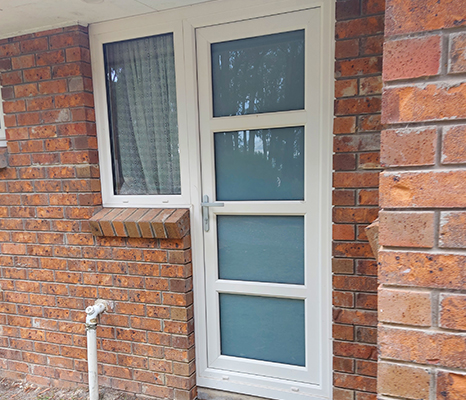
A full single-pane glass door performs poorly. But a well-designed glazed entry door with double glazing, low-e glass, an argon fill, and a thermally broken frame can deliver meaningful thermal resistance, far better than the solid timber doors many older Australian homes have had for decades.
The key variables are the frame-to-glass ratio, the glazing specification, and the method of sealing the glass into the door. More glass means more of the door’s area is subject to glazing performance rather than core insulation. That does not make a glazed door a bad choice, but it does mean the glazing specification needs to be proportionally better.
For homes where natural light in the entry is important, and in many Australian homes it genuinely is, given how much time people spend in main living areas adjacent to the entry, a high-performance glazed door can deliver light and thermal comfort simultaneously. The product just needs to be chosen carefully, not dismissed on instinct.
Australian Climate Considerations
Australia is not one climate, and a door that performs well in Cairns will have different requirements than one in Ballarat. Here is how to think about it by exposure type.
Hot and humid climates (Queensland coast, Darwin, north WA): Solar heat gain is the dominant concern. Low-e glazing with a low SHGC is important. Frame materials that resist UV degradation and humidity, fibreglass and uPVC, are well-suited. Seals that prevent humid air infiltration also reduce the risk of condensation forming inside the home when air conditioning is running.
Hot and dry inland climates (inland NSW, SA, WA): Large temperature swings between day and night mean the door needs to resist both heat gain during the day and heat loss at night. Insulated cores and well-sealed frames are important. UV resistance in finish materials matters.
Cool and temperate climates (Melbourne, Canberra, Tasmania, southern SA): Keeping warmth inside in winter is the priority. Lower U-Factor values in glazing, insulated cores, and draught-proof seals make the most difference here.
Coastal areas: Salt air is corrosive, and UV exposure is high. uPVC and fibreglass outperform uncoated steel and bare timber in these conditions. Aluminium can be used with marine-grade powder coating, but it requires maintenance.
Bushfire-prone areas: Doors in Bushfire Attack Level (BAL)-rated zones need to comply with AS 3959 construction requirements. In higher BAL zones, BAL 40 and above, standard glazed entry doors are typically not compliant; the door system needs to be specifically rated. Conflating energy efficiency compliance with BAL compliance is a common mistake; they are separate requirements.
A Framework for Comparing Doors
This is where most buying guides fall short. Knowing that energy-efficient doors exist is not the same as knowing how to compare two doors side by side and make a confident decision.
Here is what to ask and check:
- Whole-door U-Factor: The U-Factor of the glass alone tells you about the glass. The whole-door U-Factor accounts for the frame, the glass, the seals, and their interactions. It is a more meaningful number. Lower is better.
- SHGC for glazed doors: Ask what the Solar Heat Gain Coefficient of the glazing is, and confirm it suits your orientation and climate. North-facing entries in hot climates should have a lower SHGC to limit solar gain.
- Seal type and coverage: Is the perimeter seal a compression gasket or a brush seal? Is it continuous around the full perimeter? How does the multi-point lock (if fitted) contribute to seal compression?
- Threshold and sill design: Ask specifically how the door base seals. Is there an automatic drop seal? Is the sill thermally broken?
- Frame thermal performance: If the frame is steel or aluminium, is it thermally broken? What is the frame U-Factor?
- Compliance and standards: Australian Standard (AS) 2047 is the standard for windows and doors; check whether the product has been tested and is compliant. For glazing, AS 1288 covers glass selection. If the property is in a bushfire area, confirm the BAL rating of the door system.
- Warranty and maintenance: What does the warranty cover, and for how long? What maintenance does the door require to maintain its performance and warranty?
- Installation: Who installs the door, and what experience do they have with this specific product? Ask whether the installation includes full frame sealing into the reveal.
Common Mistakes That Undermine Door Performance
Several common errors undermine otherwise well-specified door installations. These are the ones most worth understanding before making a purchase decision.
Core Material Over Glass Area
A solid door with a thin, low-density core can perform worse than a well-specified double glazed door. The core material matters more than the presence or absence of glass.
Numbers Over Labels
Almost every door sold today is described as “energy efficient”. You may also see ENERGY STAR certified doors in overseas product guides; ENERGY STAR is a US program, and an ENERGY STAR label doesn’t apply to doors sold in Australia. Here, the Window Energy Rating Scheme (WERS) is the local equivalent. Ask for U-Factor, SHGC, and compliance documentation rather than accepting any label at face value.
The Threshold Problem
A beautiful, well-insulated door with a poor sill detail will still allow air to pour in underneath. The threshold is the first thing to check and often the last thing a buyer thinks to ask about.
Lifecycle Cost Over Purchase Price
A timber door with a lower upfront price but high maintenance requirements, repainting, re-sealing, swelling adjustments, can cost more over ten years than a uPVC or fibreglass option with a higher initial price and near-zero maintenance.
Orientation-Specific Glazing
The low-e coating specification that works well on a south-facing door (where you want to retain what little heat gain you get) is not necessarily the right choice for a north-facing entry in Brisbane. Ask your supplier to confirm the glazing is suited to your specific orientation.
Installation as a Performance Variable
If a door is installed with even small gaps around the frame, or a threshold that is not flush, the resulting draught pathway can negate much of the door’s thermal performance. Installation is part of the system.
The Value Case for Energy-Efficient Entry Doors
Replacing a poorly performing entry door does reduce energy costs, but the payback period depends on your situation. A home in Melbourne with a draughty old timber front door and a gas heater running through winter will see a faster comfort and cost benefit than a home in coastal Perth with a modern door that already performs reasonably well.
Comfort improvement tends to be felt before energy bill savings are measured. Eliminating a persistent draught, removing condensation from around the entry, and stabilising the temperature in the entryway are changes most people notice within days of a good installation. Energy bill savings are real but often modest on their own for a single door; the cumulative effect alongside other insulation and glazing improvements is where the gains compound.
The other value driver is durability. A quality fibreglass or uPVC door with low maintenance requirements holds its performance and appearance over twenty-plus years. A poorly maintained timber door may need to be replaced within 10 years. That lifecycle difference matters when comparing upfront costs.
Resale appeal is harder to quantify, but a well-presented, high-quality front door lifts kerb appeal (curb appeal), makes a strong first impression and signals a well-maintained, comfortable home.
Choosing the Right Energy Efficient Door
The front door is one of the more consequential parts of a home’s thermal envelope, and one that many homeowners under-specify. The difference between a draughty entry and an energy efficient front entry that holds temperature, blocks noise and seals reliably comes down to a few decisions: core quality, frame performance, glazing, seal and threshold design, and installation.
Treat it as a system rather than a product. A well-chosen door installed poorly underperforms, while a mid-range door specified for the climate and orientation and properly installed can outperform an expensive door chosen for looks alone. Ask for numbers, not descriptions, and the right energy efficient door becomes a decision you won’t second-guess.
APS Double Glazing supplies and installs double glazed uPVC entry doors across Melbourne, and the team can help you compare options for your home.
Frequently Asked Questions (FAQs)
1. What actually makes an entry door energy efficient?
An energy-efficient entry door resists heat transfer through a combination of an insulated core, a low-conductivity or thermally broken frame, quality glazing (typically double glazing with low-e coating and an argon fill), continuous perimeter seals, and a well-designed threshold. All of these components need to work together; a strong core with a poor threshold still allows significant draught.
2. Are glazed front doors less efficient than solid ones?
Not necessarily. A poorly specified solid door can underperform a well-specified glazed door. What matters is the quality of the insulated core, the glazing specification (double glazing, low-e, argon fill), and the frame and seal design. A high-quality glazed entry door can deliver genuine thermal performance alongside natural light.
3. Which door material is best for Australian homes?
It depends on your climate and priorities. uPVC is the most consistent performer across a range of Australian conditions, offering good insulation, low maintenance, and dimensional stability. Fibreglass is particularly well-suited to coastal areas due to its resistance to UV and corrosion. Timber suits heritage applications but requires more maintenance. Insulated steel is strong but needs a thermally broken frame. There is no single best answer, but uPVC and fibreglass are the easiest to maintain and consistently perform.
4. How important are seals and the threshold?
Very. Air leakage often undermines thermal performance more than buyers expect. A continuous compression seal around the perimeter, multi-point locking that presses the door firmly against that seal, and a well-designed threshold (ideally with an automatic drop seal) are essential. The base of the door is typically where the most air leakage occurs.
5. What should I look for on a product spec sheet?
Look for the whole-door U-Factor (not just the glass U-Factor), the Solar Heat Gain Coefficient (SHGC) of any glazing, compliance with AS 2047, and the glazing standard AS 1288. For bushfire-prone areas, check BAL compliance separately; it is a different certification from energy efficiency.
6. Can a poorly installed door undermine its thermal performance?
Yes, significantly. Gaps between the frame and the rough opening, inadequate sealing in the reveal, and a misaligned threshold can create air leakage paths that bypass the door’s designed performance. Professional installation by someone experienced with the specific product is part of the system, not an optional extra.
7. Is an energy-efficient entry door worth the upfront cost?
For most homeowners, replacing an older, poorly performing door is a yes. The comfort improvement is typically noticed immediately, and the reduced energy load on heating and cooling contributes to ongoing savings. The durability of quality materials like fibreglass and uPVC also reduces long-term maintenance costs, which narrows the real price gap between premium and budget options over time.
8. What should I ask a door supplier before buying?
Ask for the whole-door U-Factor and SHGC; confirm the seal and threshold design; check whether the frame is thermally broken (for steel and aluminium); confirm compliance with relevant Australian standards; ask about the installation process; and check what the warranty covers and for how long. A supplier who cannot or will not answer these questions clearly is a red flag.