
November ONLY: 35% OFF
APS IS OFFERING 35% OFF ALL ITEMS GET YOUR QUOTE NOW
APS IS OFFERING 35% OFF ALL ITEMS GET YOUR QUOTE NOW

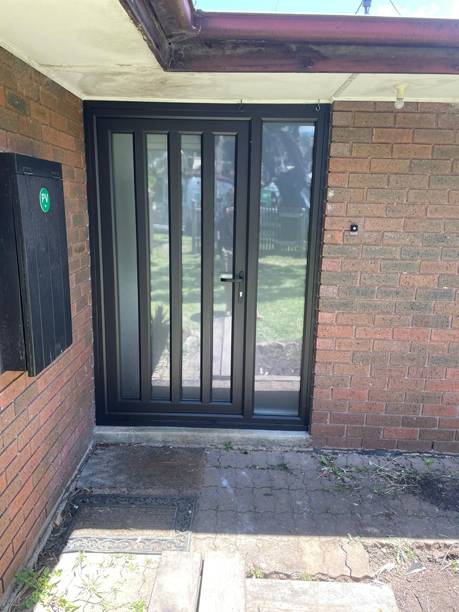
Replacing a front door is a renovation where expectations and reality often differ. Many homeowners start with “it’s just a door” and then find the cost depends on a lot of variables: material, frame condition, installation complexity, hardware and finishing.
This guide sets out what front door replacement costs in Australia today, what drives the differences, and how to choose sensibly for your budget and house.
If you’re also exploring specific door products alongside this cost research, our guides to double glazed front entrance doors and double glazed French doors cover the options in detail — useful if you’re weighing up styles, materials, and glazing specifications before committing to a product.
For a straightforward front door replacement in Australia, the total installed cost — door, hardware, and labour combined — generally falls into three tiers:
These ranges assume a standard single hinged door. Double doors, doors with sidelights, or doors requiring significant structural or framing work sit at the upper end or beyond these ranges. If your main entry is a sliding door or sliding glass door, our guide to sliding door installation costs covers that separately.
Government programs have supported renovations in the past, such as the $25,000 HomeBuilder grant, which has since closed. Check what’s currently available in your state before you commit.
Understanding the cost components helps you see where there’s flexibility and where there isn’t.
Material choice is the biggest driver of price variation in the door itself.
Aluminium front doors are the most common choice in new Australian residential construction. They’re durable, require minimal maintenance, come in a wide range of powder-coated colours, and are available in both standard and custom sizes. Supply cost for a standard aluminium front door ranges from roughly $500 to $1,800, depending on design complexity, glass inclusions, and finish. Thermally broken aluminium frames — in which the inner and outer sections are separated by a non-conductive barrier — cost more but offer better thermal performance and are worth considering in climate-sensitive applications.
Timber front doors have genuine warmth and character that aluminium doesn’t replicate. The cost varies significantly by species, grade, and construction method. Softwood doors are the most affordable timber option — with supply costs around $600 — but they require more regular maintenance, particularly in exposed locations with strong ultraviolet (UV) exposure. Hardwood and engineered timber doors provide better dimensional stability and longevity, and typically cost $1,000 to $3,000 or more, depending on quality specifications. Maintenance costs over the life of a timber door (re-staining or painting every three to five years) add to the lifetime cost.
Composite front doors use a fibreglass or composite skin over an insulated core. They offer good thermal performance, reasonable security, and lower maintenance than timber. Supply cost ranges from approximately $1,200 to $3,500. uPVC doors offer similar benefits: strong insulation, low maintenance and a finish that doesn’t need painting. Both are less widely specified in Australia than aluminium or timber, but their market share is growing.
A front door with a glazed panel, sidelights, or a highly transparent design increases both the visual impact and the cost. Glazing options — standard clear, frosted/obscured for privacy, decorative glass, or double glazed panels — add $200 to $800, depending on the type and area. Double glazed doors, which offer better thermal performance, represent a meaningful additional cost but reduce heat loss and improve comfort in the entry zone, the same way double glazed windows do.
Several factors consistently increase the total cost beyond the base tier.
The costs most homeowners don’t anticipate are those that arise once work has started.
Replacement isn’t always the answer. If the door itself is sound and only the hardware, seals or hinges have failed, a door repair can cost far less.
The case for spending more on a front door rests on a combination of security, energy performance, aesthetics, and longevity.
A better-specified door with quality multi-point locking hardware provides meaningfully better security than a basic single-latch door. Installing deadlocks on all external doors is one of the most effective steps homeowners can take. Front entries are a primary target for opportunistic break-ins, and the incremental cost of better locking hardware relative to the overall budget is modest.
A well-sealed, double glazed, or thermally broken front door reduces heat transfer at the entry — often a significant thermal weak point in the building envelope, particularly in entry halls with high ceilings and no vestibule. The energy savings are modest compared with a ceiling insulation upgrade, but, combined with improved comfort and reduced draughts, it’s a worthwhile consideration.
First impressions of a home are disproportionately formed at the front entry. A quality front door enhances the home’s presentation in ways that outweigh its cost, particularly when selling or renting. It’s one of the renovations with a strong visual-impact-to-cost ratio.
Longevity matters too. A $600 budget door that needs significant maintenance within five years and replacement within fifteen may cost more over twenty years than a $1,800 quality door that performs reliably with minimal upkeep.
If budget is the primary constraint, a standard powder-coated aluminium door in a common size with a quality single-cylinder deadlock is a reasonable, durable solution for most Australian suburban homes. Alternatively, a uPVC door gives better insulation for a similar outlay in many cases. Don’t compromise on installation quality even when the door itself is modest — a well-installed basic door outperforms a premium door installed poorly.
For mid-range budgets, the most impactful upgrades are better hardware (multi-point locking), a door design that complements the home’s architecture, and glazing that suits the home’s privacy and light conditions. Spending more on hardware than on a more elaborate door design often delivers better long-term value.
For homes where the front door is a design feature — period homes, contemporary new builds, properties being prepared for sale — the investment in a quality specified door with appropriate detailing is genuinely worthwhile and contributes to the overall impression of the home.
Front door replacement in Australia costs anywhere from around $800 to $8,000 or more, depending on material, design, hardware and installation. Most homeowners spend $1,500 to $3,500 for a quality door, standard hardware and professional installation.
The most common mistake is focusing on the door price and underestimating frame condition, finishing and hardware. Before you’re committed, have the opening measured in person and get a fully scoped quote covering removal, framework and finishing, from a business that offers a workmanship warranty.
APS Double Glazing supplies and installs double glazed uPVC front and entrance doors across Melbourne. Contact the team for a free quote.
Total installed cost typically ranges from $800 to $3,500 for most residential applications, with premium custom or architecturally specified installations reaching $5,000 to $8,000 or more. The range is wide because material, design, hardware, and installation complexity each contribute significantly.
A standard-size aluminium door in a common powder-coat colour, with a basic lockset and straightforward installation, can be done for $800 to $1,200 installed. Keeping the existing frame in usable condition eliminates the largest potential add-on cost.
For a straightforward replacement into a sound existing frame, installation labour typically runs $300 to $800. Complex installs with framework, structural modifications, or difficult access can cost $800 to $1,500 or more in labour.
Technically possible if the existing frame is sound and the new door is the same size, but it requires proper tools and experience to ensure the door is plumb, square, sealed, and secure. Improper installation can affect operation, weather sealing, and security. Most homeowners are better served by professional installation.
Aluminium is the most widely used choice for its durability, low maintenance, and weather resistance. uPVC and composite doors offer better insulation with similarly low upkeep. Quality timber is the better choice where warmth and character are priorities, and the owner is willing to maintain it. In coastal environments, marine-grade hardware and appropriate frame finishes are important regardless of material.
Not always. If the existing frame is structurally sound, plumb, and in good condition, the door can often be replaced in it. Damaged, rotted, or significantly out-of-square frames should be replaced — installing a quality door into a compromised frame undermines the investment.
Custom sizing, glazing additions, premium security hardware, frame replacement or repair, and finishing work around the reveal are the most significant cost escalators beyond the basic door supply price.
For most Australian suburban homes, upgrading to a door with quality multi-point locking and a heavier-gauge frame is worth the modest additional cost. Front entries are a primary break-in target, and the security improvement from better hardware relative to the overall project cost is favourable.